The differential is the mechanical part that provides power transmission to the rear wheels of a car or other vehicle. It basically delivers the power of the engine to the wheels. Power is transmitted to the front as well as the rear wheels. differential based on front-mounted engine and rear-wheel drive. In this post, we will cover detailed features of auto differentials and their impact on vehicle performance. So let’s get started.
What Is a Differential?
- A differential is a gear train that comes with 3 drive shafts. In this configuration, one shaft’s rotational speed is higher than the other two shafts.
- A differential is commonly employed in vehicles and helps the wheels of the drive axle to move at different speeds, normally on cornering.
- Differential is the process that delivers the torque of the engine to the vehicle’s wheels for power delivery; in this way, wheels move at different speeds.
- The differential does not work, or the vehicle moves ahead.
- Differential affects work on the vehicle during turning at different speeds.
- It also provides a clock and analogous computer operations of the vehicle. The differential also manages the gear ratio between the input and output shafts. Some differential vehicle results in gearing management with fewer teeth over the pinion compared to the ring gear.
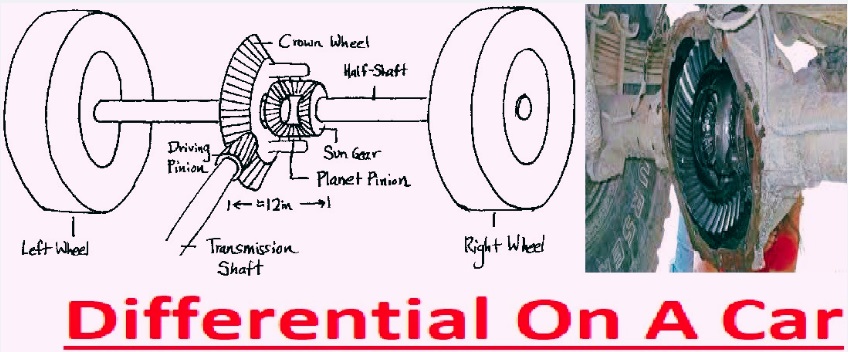
Components Of a Differential System
There are different parts of the differential system, each of which performs certain operations.
Pinion Drive Gear:
- This differential component delivers power from the driveshaft to the ring gear.
Ring Gear
- The ring gear delivers power to the casing assembly of the differential.
Spider Gear
- This part is a building block of differential.
Differential Case Assembly
- This component controls the gear and causes the axle drive.
Rear Drive Axle:
- It delivers torque from the differential assembly towards the drive wheel.
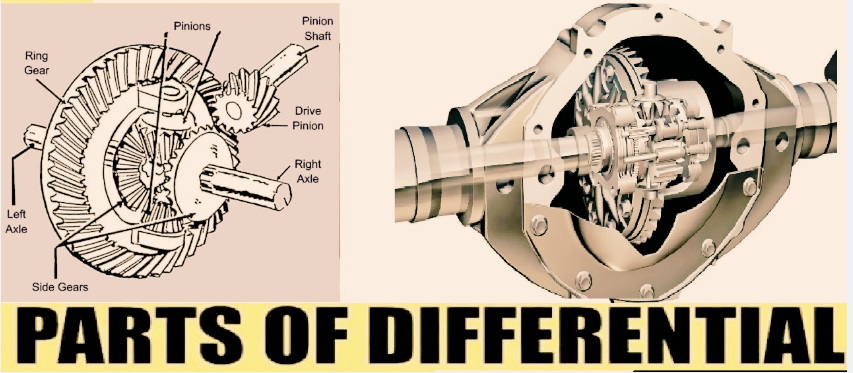
Differential Working
- During a car turn towards the right, the main gear provides the complete rotation. where the left wheel causes low rotations since it provides low movement.
- Sun gears rotate at a differential speed based on ring gear drive axle half shafts.
- So two complete turns occur; one causes the left wheel to make 12 rotations and the right wheel to make 8 rotations.
- Ring gear rotation causes the average rotation of the side sun gears. In this way, gear transmission occurs for controlling the ring gear to turn in the differential for vehicle-off conditions.
- differential work through using input torque to the ring gear, which rotates the complete carrierconfigured with sun gears and planet gears. Torque is delivered to the sun gears with planet gears.
- Planet gears move over the carrier axis that operates the sun gears.
- Planet gears move without rotation on their own axis in case both wheels have the same resistance which causes rotation of the wheels at the same rate.
- With that left sun gear facing resistance, the planet gear provides spin and revolution.
- That result left the sun gear speed reduction by making the same speed of the sun gear.
Different Types of Differentials
The main types of differential are explained as
Open DifferentialAn
- open differential is commonly used to control wheel speed variations. An open differential allows the vehicle’s external wheels to rotate more freely compared to the internal wheels.
- It does not operate properly during rough road conditions. Open differentials do not work well and face difficulty for road clearance during snow.
- It is the result of engine torque given to the wheel, which either has traction or not. The tire slip also continues spinning. Normally, vehicles have a single open differential since it has low and easy maintenance.
Limited Slip Differential
- It is like an open differential since it provides torque to vehicle wheels. But during a sharp curve, the tire slips in case of an open differential. A limited differential reduces torque delivery for tire slippage to avoid slippage. The tire has low resistance and makes strong bends for high speed for limited differential plates and clutches.
- High-performance vehicles and racing cars use limited-slip differentials.
Locking Differential
- Locking differential used when the vehicle faces off-road driving. such as high-speed cars. Locking differential comes with springs and clutches that engage when locked.
- Then uniform power is distributed for wheels, not considering traction.
Torque-Vectoring
- This differential type comes with electronic parts. It’s working to get data from the vehicle system and sensors also the steering system, road movement, and throttle position.
- Through using these data, the electronic controller operated. Torque vectoring differential is employed for high-performance vehicles. but are costlier than other types of differentials
Differential Importance in Car
basic operation of the differential to transmit power, but also causes rotation of the rear wheels of the car at different speeds.
The front wheels of the vehicle move at a different speed compared to the rear wheels. This feature is for front-wheel drive, rear-wheel drive, and all-wheel drive designs.
If a car is not using a differential, it will not move at different speeds. that increases the chance of tire slippage and degradation.
What Happens if the Differential Fails During Use?
If the differential is damaged or fails, it affects the vehicle’s working performance and increases the chances of an accident. Normally, a faulty differential causes an effect on the drivetrain that causes damage.
The main sign of differential failure is fluid leakage, grinding noise, or the vehicle not working well.
Differential damages affect the working of the vehicle during slippery roads and cornering. It also affects driving during harsh conditions.
performance of drivetrain parts, also affects like driveshafts and axles. As a result, interconnected mechanical faults exist in the differential.
Differential advantages
- It provides easy turning on bends and tight turns.
- It prevents early tire wearing since it has wheels turning at different speeds.
- It provides a car working in different conditions, and off-road movement
- Make wheels strong grip and provide stable and easy control.
Disadvantages
- Vehicles that have locking or limited-slip differential types that are high-cost increase the overall cost of the vehicle.
- Its complex design makes repairing and vehicle maintenance costly.
- Differentials also deliver power through low traction on muddy roads, which affects traction.
Conclusion
Differential main part of cardrivetrain that provides uniform cornering by helping wheel rotation with different speeds and delivers power from the engine. If your vehicle does not have a differential or has a bad differential, it will face difficulty turning, bad wear, and handling, as well as mechanical damage.
Each type of ofdifferntial provide certain applications. Proper differential working makes safe and reliable driving possible.
FAQs.
What is the function of a differential?
- basic working of the differential delivers power from engine to axle which causes rotation and helps wheel movement through different speeds. For deteriorated fluid, heat, and friction increase affects differential working.
What are the types of differentials?
- differential comes with 4 types: locking, open, torque vectoring, and limited slip
What is the operation differential in a tractor?
- differential: basically a configuration of gears that allows the rear wheels of the tractor to move at a different speed than the other.
- Through rotating the tractor on bending roads, the internal wheel moves slowly. but move faster compared to the turning point.
How a differential cylinder works
- Differential cylinders operate with two reverse piston surfaces, so they operate in two directions, like outwards and inwards.
Define differential component.
- Differential: the main part of the car that provides torque for the drive wheels and helps to move at different speeds for the turning track